
Photography Tour
explore the biodiversity of the amazon
rainforest through a camera lens.
Available as a private tour
Duration: 6 days (recommended)
Special 8-Day Yasuní Herping & Photography Expedition
Join us for an exclusive 8-day special departure deep into the heart of Yasuní National Park, designed specifically for herpetology enthusiasts and wildlife photographers. Led by a specialized expert guide, this immersive expedition explores one of the most biodiverse regions on Earth to search for rare reptiles, amphibians, and macro subjects, from iconic tree boas and bushmasters to vibrant leaf frogs and caiman lizards.
This special departure requires a minimum of 3 participants to start the tour.
Price per person: $2640
Date: July 12-19, 2027

Yasuni National Park attracts filmmakers and photographers from around the world and we have hosted both professionals and enthusiasts to look for the strangest of animals to document on camera. On this tour we combine local knowledge with skills of a professional photographer to take you on a journey to capture the breathtaking biodiversity of the Amazon rainforest. We will photograph, ethically and in situ, animals, fungi and plants according to your wishes! On this tour you will also have a chance to try camera trapping at one of our known jaguar paths.
Activity level: relaxed – moderate
Focus: photography in situ
Tour type: specialized
Focus: photography in situ
Tour type: specialized
Flexible Itinerary
The times and length of the hikes are flexible and defined by the guide the day before. The guide may modify the plan on any particular day based on weather, wildlife activity, recent sighting information, and other factors.
Tour for specialized photographers or photography lovers of all levels. A couple of days, we will have early morning activities, usually starting at 5:30 am. We have activities during the day and night. Some afternoons you will have a moment to relax, you will have some free time with your guide to go over your shots. We will spend the night hikes on nearby trails, focusing on finding all types of wildlife at a slow pace. Group will not walk too far as there is plenty of activity nearby.
Day 1: Arrival in Coca
Tour starts with morning pick-up in Coca, either from the airport or a hotel if you arrived the day before. Then, we will drive for about an hour and a half to the Tiputini Riverport. Here is where one can start to appreciate the spectacular beauty of the rainforest.
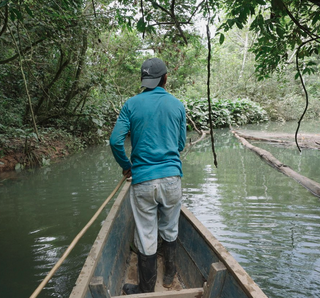
We will board a large covered motorized canoe for a 70-minute journey. We will see the beautiful surroundings we will be shooting; animal and landscape photography from the canoe from the port until arrival at the lodge.
Along the way, we will pass a few houses from the kichwa and Huaorani communities. We will see the Spectacled Owl, the Anhinga, and some Blue Morpho butterflies if we are lucky while zig-zagging along the river.
All this area is primary and secondary forest. After we arrive at the camp, we will have lunch. Then, we will have a short canoe ride for sighting and animal photography; the scenery itself may be our biggest photo asset.
Just before sunset is a great time to see animal activity. At candlelight, we will enjoy our dinner. A night walk will follow (optional), 1-3 hours taking pictures of night animals on one of the various trails near the camp.
Day 2 to 5: Photography Tour
Each day’s activities will be planned the night before, based on weather conditions, animal activity, sightings, and current hotspots known by the local guides. This area has different environments: terra firme and igapo forest, black water lagoons, and white water rivers.
Parrot clay-lick.
Birds are usually more active early in the morning; we will leave the camp around 5 am to visit this site. A short canoe ride on the Rumiyacu river and a walk will lead us to the clay lick. There are various types of parrots, like the Orange-cheeked Parrot. We will return slowly, photographing the fauna we can find like toucans, trogons, or amazing insects. We will pack some fruits and drinks to eat along the way.
El Moretal.
This site is just crossing a small river from the camp. Morete is a type of palm tree, and local refers to Moretal to a lowland flooded forest composed by this palm. This hike is near or in swamp areas. This ecosystem is a perfect area to photograph amphibians at night as well as some rare species of birds during the day, like the Long-tailed potoo.
Tiputini river.
This river flows west to east and passes all the Yasuni National Park, and in some areas, it is the natural limit between the Kichwa and Huaorani communities. This river carries a lot of nutrients in its water. We will leave early in the morning for a canoe ride; we will turn the motor off and go with the flow.
Photography is mainly done from the canoe with a couple of stops at river beaches. This is an excellent opportunity to see swallows, kiskadees, kingfishers, woodpeckers, potoos, and others. If we are lucky, we might see river dolphins. We will return to the camp for breakfast.
Blackwater lagoon.
There are a few of these in this area. We can find hoatzins, herons, pigeons, tanagers, swallows, and others. And with some luck, the giant otter. This is a mixed activity, hiking and canoeing.
Casa de la Abuela.
We will visit the «grandmother»; this is an excellent opportunity to photograph the daily life of a kichwa family, their customs, and activities. Many birds can be observed and photographed from here as oropendolas, tanagers, trogons, and a tin of different invertebrates as insects in the area. Possibility of going out for a walk from the grandma’s house to the camp doing some photography, on the way we will be able to see more wildlife.
Trails by the camp.
One trail (Peccary trail) starts just back of the restaurant, and another two trails are crossing the Tiputini River and the Yutzuyacu River from the camp. Most are loop trails with three options of length. Most of the time it is not necessary to walk long distances to get good photographs. Lots of birds and insects as grasshoppers, katydids, spiders, and some frogs are close.
Day 6: Return to Coca
Depending on your flight schedule, we might have some time for a short morning activity. We will leave the camp around 7 am, just after breakfast. Keep your camera out as there are always new findings on the way.
Not included:
-
-
Transportation Quito – Coca – Quito
-
Additional beverages and snacks; extra meals in Coca before and after the tour
-
Rain poncho
-
Tips
-
Personal Expenses
-
Travel insurance
-
Included:
Transportation Coca – Mandari Panga – Coca
Bilingual Photography guide and native guide
Accommodation in safari style tents
Use of rubber boots for hikes, life jacket for canoe travel
Three meals a day (starting with lunch on the first day through breakfast on the final day)
Purified water
TRAVEL TO AND FROM COCA
- On the first day of the tour, passengers are met in Coca in the morning (approx. 10 AM).
- At the end of the tour, passengers will be in Coca by about 10 AM, and can take a flight or bus to their next destination. This may change upon flight availability.
- Passengers beginning their tour in the morning will have the option to stop at a local restaurant for breakfast (not included), this restaurant is operated by a Kichwa women’s association to benefit community conservation projects.
COMPLETE INFO ON HOW TO GET FROM QUITO TO COCA
Extra information:
What do I need to bring and pack?
ORIGINAL PASSPORT (in waterproof plastic bag)
Fast drying, lightweight clothing including long sleeve shirts and pants
A light jacket for colder nights
Waterproof jacket or rain poncho
Sandals or walking shoes
Thick, absorbent hiking type socks
Hat or cap (MUST)
Sunglasses, sunblock and repellent (no spray)
Water bottle
One small (waterproof recommended) daypack
Flashlight or headlamp with spare batteries
Plastic bags to protect electronic equipment
Camera and Binoculars
Swimming suit
What photography equipment do I need?
Digital SLR camera (DSLR or MIRRORLESS)
Angular objective, macro (50mm and/or 90mm) and telephoto (100mm-400mm or a 600mm lens), extension tubes and teleconverters
1-2 flashes with diffusers and triggers or cable
Trusting cable
Tripod
Sufficient rechargeable batteries
Sufficient memory card
What's the climate like?
The Amazon Rainforest is characterized by rain, heat and more rain and heat (usually 72°-90°F, 22°-32°C), providing the perfect environment for plants and wildlife! The Amazon is always humid with generous amounts of rain occurring year-round. Both the rainy and “rainier” seasons are great times for an Amazon tour.
Sunshine and rain showers during the day and slightly chilly temperatures at night are a rule of thumb to go by on Amazon rainforest tours.
December and January are the driest months-with January and February being a shoulder season that leads to the months with the heaviest rainfall.
March, April, May, and June see the most precipitation in the Ecuador Amazon Basin. These months coincide with the wet seasonin the rest of the country. Rainfall in the Andes spills over into the Ecuador Amazon Basin-raising water levels of the Napo River and its tributaries.
July through December see a decline in the amount of rain that falls each month. The average temperature in the jungle remains around 25°C (77°F) year-round, but during the dry season, daytime temperatures can reach 40°C (104°F).
Is there electricity?
There is limited electricity at the lodge; there is a charging station for electronics which functions from 5 pm to 9 pm. There is electric lighting during these hours.
Is there a luggage weight limit?
There is no luggage limit weight that you can bring to the lodge.
Vaccinations and health tips:
Yellow fever and Malaria are the usual concern of our visitors. We haven’t had any cases at our campsite, but it is always recommendable to have a shot and bring medication for this, as well as a type of anti-biotic for Traveler’s diarrhea (TD).
Consult your doctor for the most current recommended health precautions for your time visiting the Amazon rainforest. The US Center for Disease Control is an excellent source for detailed information on preventing travel-related illnesses.
Other tours you might like:

Herping Tour
6 day tour available as a private tour

Birdwatching Tour
6 day tour available as a private tour
Private Tailor Made
We are open to plan new experiences. If you want to create your journey, we will be happy to make it possible.


